
Blog
E-Bike vs. Regular Bike: Which Is Better for Canadian Riders?

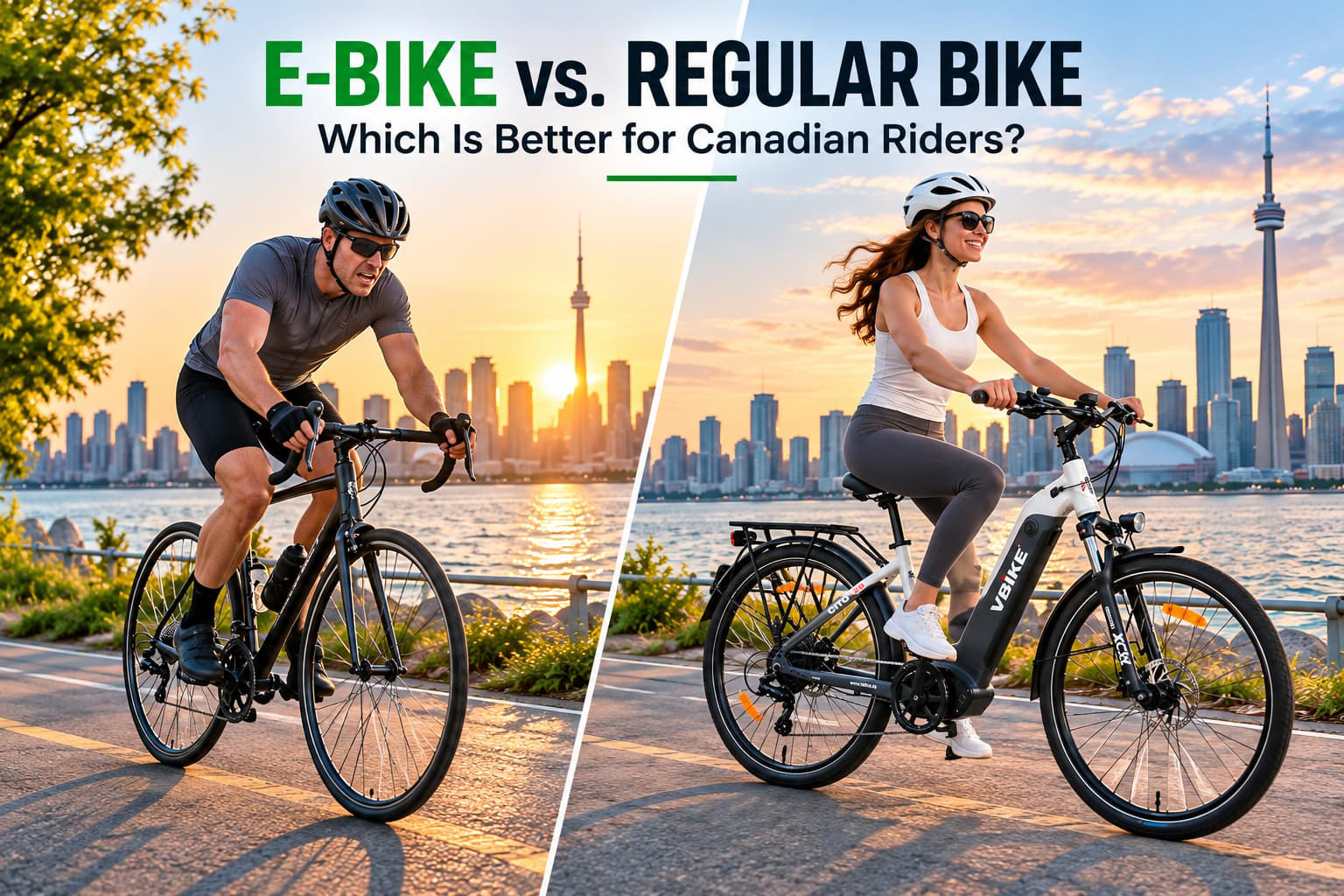
If you’re thinking about buying a new bicycle, one question probably comes up very quickly:
Should you buy an e-bike or a regular bike?
At first glance, the difference seems simple. A regular bicycle depends entirely on your legs, while an electric bike adds a battery and motor to assist you.
But in everyday use, that one difference can change almost everything—from how far you can comfortably ride and how you handle hills to whether you actually choose your bike instead of your car for a trip to work, the store or a weekend ride.
For Canadian riders, the differences can be especially important. Longer commuting distances, hills, headwinds, changing weather, carrying groceries or work gear, and simply having enough energy for the ride home can all affect how often you use your bicycle.
An e-bike can also make cycling easier for people who find a regular bicycle physically demanding.
You don’t have to be travelling 20 kilometres to benefit from electric assistance.
If pedaling a few kilometres is difficult, hills make you avoid cycling, you don’t have the strength or endurance you once had, or you’re worried about getting tired before you make it home, an e-bike can change the experience completely.
With adjustable pedal assistance—and, on vBike models, a throttle—you can choose how much effort you want to put into different parts of your ride.
Pedal normally when you feel strong, increase the assistance when the road gets harder, or use the throttle when you prefer not to pedal.
For riders who have loved cycling for years but can no longer pedal with the same strength or endurance, that flexibility may be much more important than speed.
So, e-bike vs. regular bike: which one is actually better for you?
Let’s compare them honestly.


E-Bike vs. Regular Bike: Quick Comparison
| Feature | E-Bike | Regular Bike |
|---|---|---|
| Pedaling effort | Adjustable assistance | 100% rider-powered |
| Option not to pedal | Yes, on throttle-equipped models such as vBike | No |
| Hills | Much easier for most riders | Depends on fitness and gearing |
| Headwinds | Motor assistance helps | Full effort from rider |
| Longer distances | More manageable for many riders | Limited mainly by fitness and fatigue |
| Short but physically difficult trips | Assistance can help | Can still be challenging |
| Commuting | Excellent for medium and longer trips | Excellent for shorter trips |
| Exercise | Adjustable effort | Higher effort per kilometre |
| Reduced leg strength | Motor reduces required rider effort | Rider supplies all power |
| Carrying groceries/cargo | Easier with assistance | Requires more effort |
| Different fitness levels riding together | Easier to balance | Can be challenging |
| Upfront price | Higher | Usually lower |
| Weight | Heavier | Usually lighter |
| Mechanical simplicity | More complex | Simpler |
| Charging | Required | Not required |
| Control over effort during the ride | Excellent | Limited |
The Short Answer
If you enjoy shorter recreational rides, want maximum simplicity, prioritize low weight and want cycling to provide substantial physical effort, a regular bicycle may be the better choice.
If you want to commute farther, handle hills more comfortably, carry cargo, ride despite headwinds, control how much effort you use or simply enjoy cycling without worrying as much about becoming too tired to get home, an e-bike may be the better choice.
What Is the Main Difference Between an E-Bike and a Regular Bike?
A regular bicycle converts your pedaling power into movement. Your legs provide the power.
An e-bike still works as a bicycle but adds three important components:
- an electric motor
- a rechargeable battery
- an electronic assistance system
With pedal assist, the motor supplements the effort you’re already putting into the pedals. Depending on the bike, you can normally select different levels of assistance. That means an e-bike doesn’t necessarily replace pedaling. Instead, it gives you much more control over how hard you want to pedal.
Use less assistance when you want exercise.
Increase the assistance when you’re climbing a hill.
Use more help when riding into a strong headwind.
And on a throttle-equipped e-bike, you have another option when you prefer not to pedal.
Do You Have to Pedal an E-Bike?
Not always.
This is an important difference between different e-bike designs.
With pedal assist, you pedal while the electric motor adds assistance. Depending on the assistance level you choose, you can ask the motor to contribute a little or a lot.
A throttle-equipped e-bike gives you an additional option.
Using a Throttle When You Don’t Want to Pedal
All current vBike electric bikes are equipped with a throttle, giving riders the option of motor propulsion without continuously pedaling, subject to applicable laws and operating conditions.
A throttle can be useful when:
- starting from a stop
- temporarily resting your legs
- pedaling becomes tiring
- getting through a difficult section of a route
- you want assistance getting moving
- you simply prefer not to pedal during part of your ride
This creates three different ways to approach a ride:
Pedal with little or no assistance when you want more exercise.
Use pedal assist when you want your effort supplemented.
Use the throttle when you prefer not to pedal.
That flexibility is something a regular bicycle cannot provide. For many riders, the real advantage of an e-bike isn’t that the motor replaces cycling.
It’s that you get to decide how much effort you want to use at different moments during the same ride.
Do You Still Get Exercise on an E-Bike?
Yes. This is one of the most common misconceptions about electric bikes.
On a Regular Bike
Your body provides all of the power. If the hill becomes steeper or a strong headwind starts, your effort has to increase.
On an E-Bike
You can still pedal and exercise, but the motor can supplement your effort.
Want more exercise? Reduce the assistance.
Feeling tired? Increase it.
Want to ride without pedaling for a period on a throttle-equipped bike? Use the throttle where permitted.
This makes the amount of physical effort much more adjustable. There’s another important point:
A bicycle only gives you exercise when you actually ride it.
If electric assistance encourages you to ride more frequently, take longer routes or replace trips you would otherwise make by car, an e-bike can still be part of a very active lifestyle.
Can an E-Bike Help If Pedaling a Regular Bike Has Become Difficult?
For some riders, choosing between an e-bike and a regular bike isn’t about speed at all. It’s about continuing to do something they love.
Someone may have enjoyed cycling for decades but eventually find that producing the same pedaling force has become more difficult. This can happen because of age, reduced strength, a previous injury or other physical limitations. Some riders may also experience knee discomfort or may be returning to cycling after knee surgery or another procedure.
An e-bike can reduce the amount of pedaling force required from the rider because the electric motor can share the workload. Instead of asking your legs to provide all the power, you can select an assistance level that makes riding more manageable.
Continue Cycling Even If You Can’t Pedal Like You Used To
This can be particularly meaningful for former cyclists.
You may still:
- love cycling
- enjoy being outdoors
- want to ride with friends or family
- enjoy exploring neighbourhoods and trails
- want to stay active
- want the independence of travelling by bicycle but no longer have the same strength or endurance you had years ago.
An e-bike offers another option.
You still get the familiar experience and enjoyment of riding a bicycle, but electric assistance can reduce how much physical effort is required.
And with a throttle-equipped vBike, another form of assistance is available when you prefer not to pedal.
Important: Anyone recovering from surgery or managing a medical or joint condition should follow the advice of their doctor, physiotherapist or other qualified healthcare professional before beginning or changing an exercise program.
You Don’t Have to Ride Far to Benefit From an E-Bike
One misconception about electric bikes is that you only need one if you ride long distances. That’s simply not the case.
Distance isn’t the only reason pedaling can be difficult.
Imagine that your destination is only three or four kilometres away, but the route includes:
- a steep hill
- strong headwinds
- frequent starts and stops
- carrying groceries
- reduced leg strength
- physical discomfort while pedaling
A short trip can still feel difficult on a regular bicycle.
E-Bikes Aren’t Only About Riding Farther
The real advantage is that electric assistance can make almost any ride easier when you need help.
Your destination might only be: 2 km to a coffee shop, 3 km to visit a friend, 4 km to the grocery store, 5 km around your neighbourhood.
If the physical effort required by a regular bicycle is what prevents you from riding, an e-bike can make relatively short trips more practical and enjoyable.
You don’t need an e-bike because you ride far. You may want an e-bike because it helps you ride where you want to go with an amount of effort that feels right for you.
An E-Bike Can Reduce the Worry About Getting Too Tired to Ride Home
There is another reason people sometimes limit how far they ride a regular bicycle: the return trip. You leave home feeling great. You ride 10 kilometres. Then 15. The weather is beautiful and you’re enjoying the route. You would like to keep going. But eventually you start thinking:
“If I keep riding, will I have enough energy to get back?”
On a regular bicycle, your own energy is effectively part of your range. Once your legs become tired, every remaining kilometre still has to be powered by you. An e-bike changes that equation.
Ride Farther With Assistance Available for the Return Trip
You can use low assistance while you’re fresh and want more exercise. Later, if you become tired, encounter hills or face a strong headwind on the return trip, you can increase the motor assistance. On a throttle-equipped e-bike, you also have another option for periods when you prefer not to pedal.
For someone who genuinely loves cycling, this can be one of the biggest benefits of an e-bike:
Your ride doesn’t have to end simply because you’re worried about saving all your energy for the trip home.
Of course, your e-bike’s battery has its own range, so longer rides should always be planned around remaining battery capacity.
Range varies according to factors including:
- battery capacity
- assistance level
- rider weight
- terrain
- temperature
- wind
- tire pressure
- riding style
- throttle use
- stop-and-go traffic
With appropriate battery capacity and route planning, however, electric assistance can give riders much greater flexibility to explore farther.
E-Bike vs. Regular Bike for Commuting
For many Canadians, commuting is where the advantages of an e-bike become particularly obvious.
Imagine that work is 10 or 15 kilometres away. On a regular bicycle, you may be perfectly capable of riding that distance. But you also need to consider:
- arriving sweaty
- hills along the route
- headwinds
- carrying a laptop or work bag
- the return trip after a long workday
- whether you’ll want to do the same ride again tomorrow
An electric bike doesn’t eliminate cycling. It makes the amount of effort much more controllable. You can use more assistance on the way to work and reduce it when you have more time or want additional exercise.
For commuters in Toronto, Vaughan, Richmond Hill, Mississauga and other Canadian communities, that flexibility can help turn a bicycle from occasional recreation into practical everyday transportation.
An E-Bike May Be Better for Commuting If You:
- regularly travel medium or longer distances
- encounter hills or strong headwinds
- carry a backpack, groceries or work equipment
- don’t want to arrive exhausted
- want to reduce some short car trips
- want to cycle more frequently
- want control over how much effort you use
A Regular Bike May Be Better If You:
- have a very short and easy commute
- want maximum exercise
- have shower/change facilities at work
- regularly carry your bicycle upstairs
- don’t want to charge a battery
- prioritize minimum bicycle weight
Which Is Better for Hills: E-Bike or Regular Bike?
For most everyday riders, the e-bike has a significant advantage on hills.
On a traditional bicycle, climbing depends heavily on:
- rider fitness
- bicycle gearing
- rider and cargo weight
- gradient
- wind
With an e-bike, the motor contributes additional power. That means you can climb while putting considerably less effort through the pedals. But not every e-bike handles hills in exactly the same way.
Hub-Motor E-Bikes
Hub motors can provide a practical combination of performance, reliability and simplicity for everyday riding.
Several vBike commuter models use 500W BAFANG geared hub motors designed to provide assistance for everyday roads, commuting and hills.
Mid-Drive E-Bikes
Riders who regularly encounter steeper hills may also consider a mid-drive e-bike. Because a mid-drive works through the bicycle drivetrain, it can provide excellent climbing performance and a natural riding experience.
vBike offers mid-drive options including CITO 26M, CITO 28M and LEVO 28M.
E-Bike vs. Regular Bike for Headwinds
Headwinds don’t usually appear on bicycle specification sheets, but they can dramatically change a ride. A comfortable outward journey can become a difficult return trip when the wind changes direction.
On a regular bicycle, your body has to overcome that additional resistance. On an electric bike, you can increase your pedal-assist level.
This illustrates an important advantage of an e-bike:
The motor isn’t only there to make riding faster. It can make the effort required for your ride more predictable.
Hills, wind and fatigue can change during a trip. Your assistance level can change with them.
E-Bike vs. Regular Bike for Longer Distances
Technically, a regular bicycle doesn’t have a battery range. As long as you have the energy to keep pedaling, you can keep riding. But for many everyday cyclists, physical fatigue becomes the practical range limit.
An e-bike changes that. Motor assistance can make a 20, 30 or 40 km ride more manageable, depending on the rider, route and bicycle. This is why serious e-bike buyers should consider battery quality and capacity rather than simply focusing on motor power.
Several vBike commuter models combine removable 48V batteries using branded Samsung or Panasonic cells with efficient electric drive systems. Selected Dual Battery vBike models also offer optional dual-battery configurations for riders who need additional battery capacity.
What Happens If an E-Bike Battery Runs Out?
An e-bike can still be pedaled when the battery is depleted. It remains a bicycle. However, electric bikes are generally heavier than regular bicycles because of their battery, motor and additional components. As a result, pedaling an e-bike without electric assistance may require more effort than riding a lightweight regular bicycle.
This is why choosing appropriate battery capacity and monitoring your remaining charge are important—particularly on longer rides. A removable battery can also make charging more convenient because you can take the battery indoors rather than bringing the entire bicycle to an outlet.
Is an E-Bike Faster Than a Regular Bike?
Not necessarily. A strong cyclist on a lightweight road bicycle can ride faster than an e-bike in many situations. The practical advantage of an e-bike isn’t necessarily its maximum speed. It’s consistency and assistance.
Electric assistance can help you:
- accelerate more easily
- maintain your pace into headwinds
- climb hills with less slowdown
- maintain a steadier pace over longer distances
For everyday riders, this can make travel time and effort more predictable.
How Fast Can an E-Bike Go in Ontario?
Under Ontario’s current e-bike requirements, qualifying e-bikes have a maximum motor-assisted speed of 32 km/h and a motor not exceeding 500 watts, along with other equipment and operating requirements.
Riders should always check current provincial and municipal rules for the areas where they intend to ride.
E-Bikes Can Help Riders With Different Fitness Levels Ride Together
Imagine that one partner has cycled regularly for years while the other hasn’t ridden much recently. On regular bicycles, the stronger rider may constantly need to slow down while the other person struggles to keep up.
Electric assistance can help reduce that difference. The person who needs more help can select a higher assistance level while the stronger rider uses less assistance—or rides a regular bicycle. This can make riding together more enjoyable because the trip becomes less about matching physical ability and more about enjoying the route together.
For couples, friends or family members with different endurance levels, this can be another compelling reason to consider an e-bike.
Which Costs More: E-Bike or Regular Bike?
A regular bicycle generally wins on initial purchase price when comparing similar quality levels.
An e-bike requires additional components:
- motor
- lithium-ion battery
- controller
- display
- sensors
- wiring
- electrical controls
Those components increase the cost. But initial purchase price isn’t the only consideration. A better question is:
How much will you actually use the bicycle?
If you buy a less expensive regular bicycle but rarely use it because your commute is too long, the hills are difficult or you’re worried about getting tired, its lower price hasn’t necessarily produced better value.
If an e-bike becomes something you use regularly for commuting, errands and recreation, the higher initial cost may be easier to justify. An e-bike can also potentially replace some trips you would otherwise make by:
- car
- rideshare
- taxi
- public transit
An e-bike doesn’t have to replace your car completely to become useful transportation.
Is an E-Bike Harder to Maintain Than a Regular Bike?
Somewhat—but much of the routine maintenance is the same.
Both regular bicycles and e-bikes require attention to:
- tires
- brakes
- chain
- gears
- bearings
- wheels
- fasteners
An e-bike still requires many of the same basic maintenance tasks as a regular bicycle, including checking tire pressure, brakes, drivetrain components and fasteners. Following a regular e-bike maintenance routine can help keep the bike performing properly and identify small issues before they become bigger problems.
An e-bike adds:
- battery
- motor
- controller
- wiring
- sensors
- display
That’s why after-sales support matters when choosing an e-bike.
The cheapest e-bike isn’t necessarily the least expensive bike to own if replacement parts, technical support or knowledgeable service become difficult to obtain.
vBike provides technical support and dedicated service for vBike owners, and vBike bicycles are inspected, adjusted and tested before delivery.
E-Bike vs. Regular Bike Weight
This is one area where the regular bicycle has a clear advantage. E-bikes are heavier. The motor and battery add weight, and the frame and other components may also be designed for the additional loads associated with an electric bicycle.
This matters if you:
- carry your bicycle up several flights of stairs
- frequently lift it into a vehicle
- need an extremely lightweight bicycle
- regularly combine cycling with public transit
If storage space is your bigger concern, however, a folding e-bike can substantially reduce the bicycle’s footprint.
vBike models including the LEVO 20, LEVO 20S, CITO 18 and CITO 20 combine electric assistance with compact designs.
Are E-Bikes Good for Beginners?
For many new and returning riders, yes. Electric assistance can make cycling feel less intimidating because hills, longer distances and fatigue become easier to manage. However, an e-bike is generally heavier than a regular bicycle.
New riders should take time to become comfortable with:
- braking
- acceleration
- throttle operation
- pedal-assist levels
- turning
- bicycle weight
- starting and stopping
Frame design can also make a significant difference. For riders who prioritize easy mounting and a comfortable riding position, a step-through e-bike can be appealing.
vBike models such as the CITO 26 and CITO 28 combine step-through frames with torque-sensing pedal assistance for a smooth and natural response to rider input.
Why an E-Bike Can Keep You Cycling for More Years
For many people, cycling isn’t simply transportation. It’s something they’ve loved for years. But physical ability can change. Hills may begin to feel steeper. Long rides may feel longer. Headwinds may become more frustrating. The distance you comfortably ride may gradually shrink. That doesn’t necessarily mean you need to give up cycling.
An e-bike provides another option. Instead of stopping because you can no longer ride exactly as you did before, electric assistance allows you to adapt the amount of effort to your current abilities. Use less assistance when you’re feeling strong. Use more when you’re tired. Use the throttle when you prefer not to pedal. Take a short ride today. Enjoy a longer ride tomorrow.
For someone who genuinely loves cycling, this may be one of the most important benefits of an e-bike:
It can help keep the joy of cycling accessible even when your strength, endurance or circumstances change.
Are E-Bikes Worth It in Canada?
For the right rider, an e-bike can absolutely be worth considering. But not everyone needs one.
An E-Bike May Be Right for You If:
- your commute feels too long on a regular bicycle
- hills make you avoid certain routes
- you regularly encounter headwinds
- pedaling requires more effort than you’re comfortable with
- you want to arrive at work with less exertion
- you want to ride farther
- you worry about becoming too tired to get home
- you carry groceries or work gear
- you want to cycle more frequently
- you want assistance available when you’re tired
- you want the option of using a throttle
- you want to replace some short car trips
- your strength or endurance isn’t what it once was
- you want to ride with someone whose fitness level is different from yours
A Regular Bike May Be Better If:
- your rides are short and physically easy
- fitness training is your main objective
- your budget is limited
- you need the lightest possible bicycle
- you frequently carry your bike upstairs
- you want the simplest possible mechanical system
- you don’t want to charge a battery
There is no reason to claim an e-bike is automatically better for everyone. The better bicycle is the one that fits your needs and the way you actually ride.
Why Canadian E-Bike Buyers Should Look Beyond Motor Power
Once you’ve decided an e-bike is right for you, it’s easy to start comparing bikes based entirely on motor wattage and advertised range. Those numbers matter. But they don’t tell the whole story.
1. Battery Quality
Battery quality matters for performance, reliability and ownership.
vBike uses battery packs with branded cells, including Samsung, LG, and Panasonic, on applicable models.
2. Motor Quality
A reliable electric drive system is critical.
Many vBike models use BAFANG geared hub motors, while selected models offer mid-drive systems for riders seeking different performance characteristics.
3. Pedal-Assist Sensor
Not all pedal-assist systems feel the same. Torque sensors respond to the force you’re applying to the pedals, helping provide a smoother and more natural riding experience.
Models including the CITO 26 and CITO 28 use axle torque sensors.
4. Throttle
A throttle adds another level of flexibility.
All current vBike e-bikes include a throttle, allowing riders to use motor propulsion when they prefer not to pedal, subject to applicable laws and riding conditions.
5. Brakes
Electric bicycles are heavier than many traditional bicycles, making dependable braking particularly important.
Selected vBike commuter models use TEKTRO hydraulic disc brakes.
6. Tires
Punctures can quickly turn a convenient commute into an inconvenience.
Selected vBike commuter models such as the CITO 26 and CITO 28 use Schwalbe puncture-resistant tires with reflective sidewalls.
7. Battery Flexibility
If you ride unusually long distances, battery capacity may matter more than having the most powerful motor.
Selected vBike commuter models offer optional dual-battery configurations.
8. After-Sales Support
This may be one of the most overlooked e-bike features.
A regular bicycle can generally be serviced by many bicycle shops. An electric bike combines mechanical and electrical systems, so access to technical knowledge, compatible parts and product-specific support becomes more important.
vBike provides dedicated technical support and service for vBike owners in Ontario.
9. Assembly and Inspection
vBike electric bikes are assembled, adjusted, inspected and tested before delivery rather than requiring customers to assemble a complete bicycle themselves from a shipping box.
For first-time e-bike buyers, that can remove another source of uncertainty.
E-Bike vs. Regular Bike: Final Verdict
There isn’t one winner for every Canadian rider.
A regular bicycle is difficult to beat for simplicity, low weight, lower upfront cost and cycling where physical effort itself is a major part of the goal.
But an e-bike becomes particularly compelling when you want your bicycle to do more.
If you want to:
- commute farther
- make hills easier
- handle headwinds
- carry groceries
- control how much effort you use
- ride despite reduced strength or endurance
- enjoy longer recreational rides
- worry less about being too tired for the return trip
- continue enjoying cycling as your abilities change
- or simply have the option of assistance whenever you want it
an e-bike can make cycling significantly more practical. So perhaps the most useful question isn’t:
“Is an e-bike better than a regular bike?” Instead, ask yourself:
“Which bike will help me ride more often, go where I want to go and enjoy the ride?”
If distance, hills, fatigue or the physical effort of pedaling currently limits where—or whether—you ride, an e-bike may remove that limitation.
Ready to Find the Right E-Bike?
Once you’ve decided electric assistance makes sense for you, don’t simply choose the bike with the biggest motor or highest advertised range.
The right e-bike should match your:
- height
- riding distance
- terrain
- storage space
- preferred riding position
- desired level of assistance
- everyday use
vBike Canada offers electric bikes for a variety of Canadian riders—from compact folding e-bikes and comfortable step-through commuters to full-size and mid-drive models.
Frequently Asked Questions About E-Bikes vs. Regular Bikes
Is an e-bike better than a regular bike?
Neither is universally better. An e-bike is generally more practical when riders want assistance with longer distances, hills, headwinds, commuting, carrying cargo or physical effort. A regular bicycle is lighter, mechanically simpler, generally less expensive and excellent for exercise-focused riding.
Is an e-bike worth buying in Canada?
An e-bike can be worth buying if electric assistance helps you commute farther, ride more frequently, manage hills, carry cargo, reduce some car trips or continue cycling when a traditional bicycle has become physically demanding.
Do you have to pedal an electric bike?
With pedal assist, the rider pedals while the motor supplements their effort. Some e-bikes also include a throttle. All current vBike e-bikes are throttle-equipped, providing another option when the rider prefers not to pedal, subject to applicable laws and riding conditions.
Can you ride an e-bike without pedaling?
A throttle-equipped e-bike can provide motor propulsion without continuous pedaling. However, laws and operating requirements vary by jurisdiction, so riders should always follow applicable provincial and municipal rules.
Do you get exercise on an e-bike?
Yes. Riders can pedal and choose lower assistance levels when they want more physical effort. One advantage of an e-bike is that the rider can adjust the amount of assistance according to the ride and their energy level.
Are e-bikes good for people with knee problems?
Electric assistance can reduce the amount of force a rider needs to apply through the pedals, which may make cycling more manageable for some people. However, anyone with knee problems, recovering from knee surgery or managing another medical condition should consult and follow the advice of their healthcare professional before cycling.
Are e-bikes good for older riders?
They can be. Electric assistance can help riders manage hills, distance, headwinds and reduced endurance. Easy-access frame designs such as step-through e-bikes may also appeal to some riders. The appropriate bicycle depends on the individual’s abilities, comfort and needs.
Are e-bikes easier to ride uphill?
Generally, yes. The motor supplements the rider’s effort, making hills easier for many riders compared with a regular bicycle.
What happens if an e-bike battery dies?
An e-bike can still be pedaled, but because electric bicycles are generally heavier than regular bikes, pedaling without motor assistance may require more effort.
Are e-bikes good for commuting?
Yes. E-bikes can be particularly useful for commuting because electric assistance makes longer distances, hills, headwinds and carrying work gear easier while allowing riders to control their level of exertion.
How fast can an e-bike go in Ontario?
Under Ontario’s current requirements, qualifying e-bikes have a maximum motor-assisted speed of 32 km/h and a motor not exceeding 500 watts, along with other requirements. Riders should check current provincial and municipal rules before riding.
Are e-bikes more expensive to maintain than regular bikes?
They can be because an e-bike adds electrical components such as a motor, battery, controller, sensors and display. Routine bicycle maintenance—including brakes, tires, wheels and drivetrain—is otherwise similar.
Which e-bike is best for a first-time rider?
The best e-bike depends on the rider’s height, terrain, typical distance, storage requirements and preferred riding position. Step-through models can make mounting and dismounting easier, folding e-bikes can work well where storage space is limited, and mid-drive models may appeal to riders who regularly encounter hills.
Explore vBike Canada Electric Bikes
From compact folding e-bikes to comfortable step-through commuters and mid-drive models, vBike Canada offers electric bikes designed for different riders, routes and lifestyles.
Whether you’re looking for an easier daily commute, want to ride farther, need help with hills, don’t want fatigue to determine when your ride ends, or simply want the freedom to choose how much effort you put into each trip, there’s a vBike designed to help you enjoy the ride.